Men’s Outerwear Guide: Jackets & Coats Explained
If you own more than two jackets and still reach for the same one every day, the problem usually isn’t your wardrobe — it’s that you never learned which outerwear piece belongs to which temperature range, fabric, and occasion.
This guide breaks men’s outerwear into a simple temperature-and-occasion system, with exact fabric names, fit checkpoints, and price tiers, so you can build a small rotation that actually covers your life instead of a closet full of jackets you don’t trust yourself to wear.
Key Takeaways
- Outerwear falls into two families: structured coats (peacoat, overcoat, trench) for smart occasions, and casual jackets (bomber, field, trucker, parka) for everything else. Mixing them up is the single most common style mistake.
- Match the garment to a temperature band, not just “winter” or “summer” — a wool overcoat and a down parka are both “winter coats,” but they solve different problems.
- Three fit checkpoints matter more than brand or price: shoulder seam placement, sleeve length, and hem length relative to your jacket or shirt underneath.
- You need 3-5 pieces to cover a full year in most temperate climates, not 10.
- Fabric weight (measured in ounces or GSM) tells you more about real-world warmth than the garment’s category name does.
What’s the Actual Difference Between a Jacket and a Coat?
A coat is any outer layer that falls at or below the hip and is designed to be worn over a suit jacket or blazer — think overcoats, trenches, and peacoats. A jacket is shorter, ends at or above the hip, and is usually the outermost layer on its own, like a bomber, field jacket, or trucker jacket.
This distinction matters because coats are built for formal and business layering, while jackets are built to be the whole outfit’s outer statement, which affects how they should fit and what you wear underneath them.
The Temperature Ladder: An Original Framework for Building Your Rotation
Most style guides sort outerwear by season, which fails the moment you travel somewhere with a different climate or hit an unseasonably warm January. Instead, sort by the temperature range where the garment actually performs well. I use this framework with styling clients because it survives climate variation and travel:
Band 1 — 60-70°F (mild, breezy evenings, early fall): A single mid-weight layer with no real insulation. This is trucker jacket, unlined field jacket, or a cotton overshirt territory. Fabric weight: 10-14 oz cotton canvas or denim.
Band 2 — 45-60°F (true fall, cool spring): A jacket with light insulation or a wool blend. This is bomber jacket with a quilted or fleece lining, a lightweight wool overshirt, or an unlined trench. Fabric weight: 16-20 oz wool flannel, or a quilted nylon shell with 60g synthetic fill.
Band 3 — 30-45°F (real winter in temperate cities): Structured wool coats and mid-weight parkas. This is where your peacoat, overcoat, or a parka with 100-150g of insulation lives. Fabric weight: 24-32 oz melton wool (an 80/20 wool-nylon blend is standard and more durable than 100% wool).
Band 4 — Below 30°F (deep winter, wind exposure): Down parkas and heavy technical shells. Look for 550-fill-power down or higher, or a wool coat rated at 32 oz or heavier worn over a sweater. Fill power measures the down’s loft per ounce — 550 is a reasonable floor, 700+ is genuinely warm without excess bulk.
The mistake I see most often in real closets: guys own three Band 3 coats and nothing for Band 1 or 2, so they either overheat in a heavy coat on a 55-degree day or go without a jacket entirely and look underdressed.
The Core Outerwear Types, Explained
Peacoat
A double-breasted wool coat, traditionally navy, that hits mid-thigh and originated as naval workwear. It sits in Temperature Band 3 and is the single most versatile “smart-casual to business-casual” coat a man can own, because it works over a blazer, a sweater, or a t-shirt without looking mismatched to any of them.
- Fabric: Melton wool, ideally 70-80% wool blended with nylon or polyester for structure and durability. Pure wool drapes better but pills faster.
- Fit check: The shoulder seam should sit right at the edge of your shoulder bone, not an inch past it — a dropped shoulder seam is the number one sign of an oversized coat that will read as sloppy rather than relaxed.
- Price tiers: Budget ($120-180, look for a wool-blend from Uniqlo or J.Crew Factory), mid ($250-400, Spier & Mackay or Suitsupply), premium ($600+, Sandro or a made-to-measure option).
Overcoat (Topcoat)
A single- or double-breasted coat that falls to the knee or just above, worn over a suit for business or formal occasions. This is the coat you wear to a January wedding or over a suit on a commute — it is not a casual piece, and wearing one over jeans and sneakers undercuts its entire purpose.
- Fabric: Worsted wool or a wool-cashmere blend, 26-32 oz.
- Fit check: Sleeve length should end where your suit jacket sleeve ends, roughly at the wrist bone, so both cuffs are visible when your arms hang naturally.
- Situational example: For a 6’0″ average build attending a December wedding in a suit, a charcoal wool overcoat that stops 1-2 inches above the knee reads as correctly proportioned; anything longer starts to look like it belongs to an older, more formal era of dressing.
Trench Coat
A belted, single- or double-breasted cotton gabardine coat, traditionally khaki, that falls to mid-calf. It’s a transitional piece for Band 2 rain and wind, not real cold, and its defining trust signal is the fabric: genuine gabardine is tightly woven cotton twill that resists light rain without being a technical waterproof fabric.
- Fabric: Cotton gabardine, 9-12 oz, sometimes with a small percentage of polyester for shape retention.
- Fit check: The hem should hit between mid-calf and just above the ankle — shorter reads as a casual jacket cosplaying as a trench, which undermines the whole point of the silhouette.
- Common mistake: Buying a trench in black. The classic khaki or stone color is part of what makes the trench read as intentional rather than like a raincoat you grabbed in a hurry.
Field Jacket / M-65 Style
A cotton or cotton-blend jacket with a shirt collar, four flap pockets, and a straight, boxy cut, originally military. Sits in Band 1 to Band 2 depending on lining. It’s the most forgiving casual jacket for guys who feel overdressed in a blazer but underdressed in a hoodie.
- Fabric: 10-14 oz cotton canvas, sometimes with a removable quilted liner for cold weather.
- Fit check: Should sit at or just below the hip with about two inches of ease through the chest when zipped — enough room for a flannel shirt underneath without pulling at the buttons.
Bomber Jacket
A waist-length jacket with ribbed cuffs and hem, originally a flight jacket. Works in Band 1 to Band 3 depending on the shell fabric and lining, and reads more casual than a field jacket because of the ribbed trim.
- Fabric: Nylon or polyester shells with quilted lining for cold weather; suede or leather for a dressier casual look that pairs well with chinos.
- Fit check: The ribbed hem should sit at your natural waist, not below it — a bomber that hangs past the waist loses the silhouette that makes the style work.
- Situational example: For a 5’8″ athletic build going to a casual fall dinner, a navy or olive nylon bomber over a plain crewneck and dark jeans reads clean; the same jacket in an oversized cut on the same build will look like borrowed clothing.
Trucker Jacket / Denim Jacket
A waist-length cotton or denim jacket with a point collar and chest pockets, unlined or lightly lined. Firmly Band 1, layering piece, not a cold-weather solution on its own.
- Fabric: 12-14 oz denim (raw or washed) or cotton canvas.
- Fit check: Should be snug enough to layer a t-shirt underneath but not a heavy sweater — if you can comfortably fit a hoodie under it, it’s sized too large.
Parka
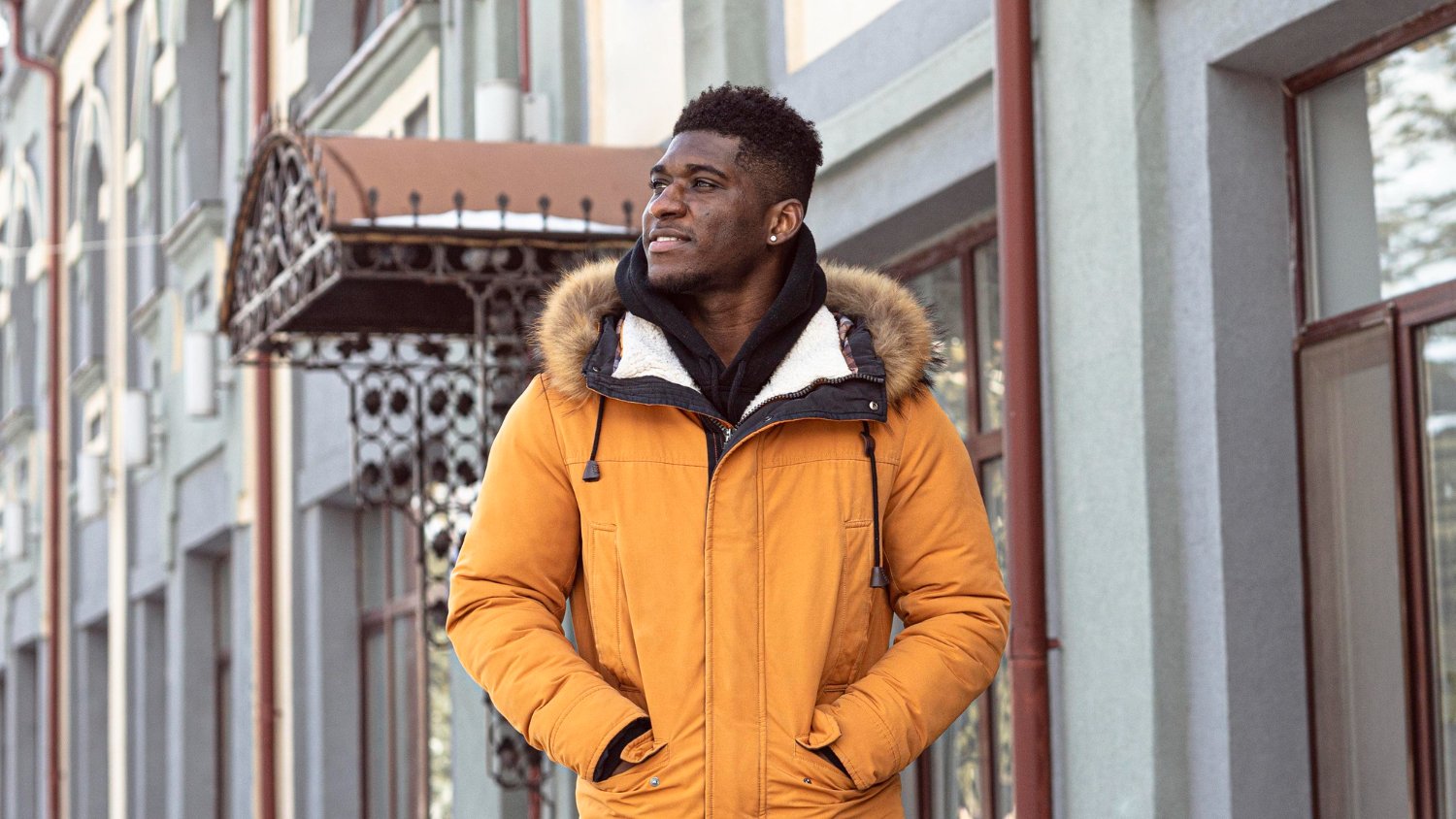
A longer, hip-to-thigh length jacket with a hood, built for real cold and often wind or water resistance. Spans Band 3 to Band 4 depending on fill weight.
- Fabric: Nylon or cotton-nylon shell with down or synthetic insulation; 100-150g fill for Band 3, 150g+ or down for Band 4.
- Fit check: Should accommodate a sweater underneath without restricting arm movement at the shoulder — raise your arm overhead in the fitting room; if the hem rides up past your beltline, the torso is too short for layering.
Overshirt (Shirt Jacket)
A heavier shirt, usually flannel, wool, or corduroy, cut to be worn open as a light layer rather than tucked in. This is a newer addition to most men’s rotations and solves the Band 1-2 gap better than almost anything else because it looks intentional buttoned or open, alone or over a t-shirt.
- Fabric: Wool flannel (10-14 oz), brushed cotton flannel, or corduroy.
- Fit check: Should be roomy enough through the shoulders to layer over a t-shirt, with sleeves that end at the wrist bone — the overshirt is the one category where a slightly boxier fit is correct, not a flaw.
Read also: 20 Cargo Pants Outfit Ideas for Men
Comparison Table: Outerwear by Occasion and Temperature Band
| Garment | Temp Band | Best Occasion | Fabric | Typical Price Range |
|---|---|---|---|---|
| Trucker/Denim Jacket | 1 | Weekend, casual errands | 12-14 oz denim/canvas | $60-180 |
| Overshirt | 1-2 | Casual to smart-casual | Wool flannel, corduroy | $70-220 |
| Bomber Jacket | 1-3 | Casual, dinner, travel | Nylon, suede | $90-350 |
| Field Jacket | 1-2 | Casual, weekend errands | Cotton canvas | $100-300 |
| Trench Coat | 2 | Smart-casual, rainy commute | Cotton gabardine | $150-450 |
| Peacoat | 3 | Smart-casual to business-casual | Melton wool blend | $120-600 |
| Overcoat | 3 | Business, formal, over a suit | Worsted wool/cashmere blend | $250-900 |
| Parka | 3-4 | Deep cold, commuting, travel | Nylon shell, down/synthetic fill | $150-600 |
How to Verify Fit In Person (Not Just From the Size Tag)
Size tags vary too much between brands to trust on their own, so check these three things every time, regardless of what the label says:
- Shoulder seam: With your arms relaxed at your sides, the seam should sit exactly at the edge of your shoulder bone. If it hangs off the edge, size down; if it pulls inward toward your neck, size up.
- Sleeve length: For jackets, sleeves should end at the wrist bone. For coats worn over a suit, the coat sleeve should be slightly longer than your suit jacket sleeve so no shirt cuff shows past the coat.
- Hem and layering room: Sit down in the jacket. If the hem rides up dramatically or the shoulders strain, the cut is too slim to layer or move in comfortably over a season of real use.
A Common Mistake Worth Naming
The most frequent error I see is buying outerwear for the season it’s purchased in rather than the season it will be worn in. Someone shops for a coat in November, buys the heaviest thing on the rack because it’s cold that day, and ends up with a Band 4 parka that’s overkill for the 45-degree days that make up most of a typical winter. Buy for the temperature band you’ll wear the piece in most often, not the coldest day you can imagine.
FAQ
Do I need both a peacoat and an overcoat? Not necessarily. If your work is business-casual and you rarely wear a suit, a peacoat covers both smart-casual and semi-formal needs. An overcoat is worth adding only if you regularly wear a suit and need a coat that fits over it without bulk.
Can I wear a casual jacket like a bomber with a suit? No — this is a common mismatch. Bombers, truckers, and field jackets are casual pieces built to be the outermost, standalone layer; a suit calls for a coat category (peacoat, overcoat, or trench) that’s cut to fit over structured tailoring.
What’s the most versatile single outerwear piece for a man who only wants one? A navy peacoat in melton wool. It works over a t-shirt, a sweater, or a blazer, spans business-casual to weekend, and covers Temperature Band 3, which is the range most temperate climates spend the most days in.
How do I know if a coat is too big instead of just “relaxed fit”? Check the shoulder seam first — if it hangs past your shoulder bone, it’s oversized, not relaxed. A genuinely relaxed cut adds room in the chest and waist while keeping the shoulder seam accurate, since the shoulder is a structural point that doesn’t stretch to fit like fabric elsewhere.
Is a 100% wool coat better than a wool blend? Not automatically. A wool-nylon or wool-polyester blend (usually 70-80% wool) holds its shape better over years of wear and resists pilling more than 100% wool, which drapes slightly better but shows wear faster. For a first coat, a quality blend is the more durable choice.
What fill power do I actually need in a down jacket? For most temperate winters (Band 3), 550-600 fill power is enough. Reserve 700+ fill power for genuinely harsh cold or high-altitude use — higher fill power mainly reduces bulk for the same warmth rather than adding dramatically more warmth on its own.
Read also: