Business Casual for Men: What It Actually Means (2026)

Business casual means dark or neutral trousers (chinos or wool-blend dress pants), a collared shirt or quality knit, and leather shoes — with a sport coat optional but no tie required.
The most common mistake is treating it as “office-casual Friday,” when in most workplaces it still means no jeans, no sneakers, and no t-shirts as your top layer.
If that first paragraph felt slightly different from every other definition you’ve read, that’s intentional — because “business casual” doesn’t mean one fixed thing. It’s a sliding scale, and where your office sits on that scale changes everything you should wear.
I’ve spent over a decade dressing men for job interviews, client meetings, and offices ranging from law firms to ad agencies, and the single biggest wardrobe mistake I see is men applying a rigid definition to a flexible dress code.
Key Takeaways
- Business casual sits on a spectrum between “business professional” (suits, ties) and “smart casual” (more relaxed, trend-driven pieces). Most offices land in the middle third of that spectrum.
- The core formula: tailored trousers or chinos + collared shirt or fine-gauge knit + leather shoes + optional unstructured blazer.
- Fabric and fit matter more than the specific garment. A wrinkled dress shirt reads worse than a crisp, well-fitted knit polo.
- The three checkpoints that separate “put together” from “sloppy” are the shoulder seam, the trouser break, and the collar gap — details covered below.
- When in doubt, dress one notch above your workplace’s stated minimum. It’s easier to remove a blazer than to explain why you showed up underdressed to a client meeting.
What Does “Business Casual” Actually Mean?
Business casual is a workplace dress code that removes the requirement for a suit and tie but still expects tailored, put-together clothing — no denim, no athletic wear, no flip-flops, and no visible logos larger than a small embroidered mark.
The confusion exists because the term was never standardized. It emerged in American offices in the 1990s as a relaxed alternative to full business formal, and every company since has interpreted it slightly differently.
A law firm’s “business casual” Friday might still mean a blazer and tie is welcome; a tech startup’s might mean a clean henley is fine. Neither is wrong — but if you show up dressed for the wrong one, you’ll either look overdressed and stiff, or underdressed and careless.
The fix isn’t finding “the” definition. It’s learning to read the specific room you’re walking into, which is what the next section covers.
The Dress Code Spectrum: Where Business Casual Actually Sits
Most men picture dress codes as three separate boxes: formal, business casual, casual. In reality it’s one continuous line, and business casual covers a wide middle stretch of it. Here’s how I break it down for clients:
| Dress Code Level | Core Pieces | Footwear | Typical Setting |
|---|---|---|---|
| Business Professional | Matched suit, dress shirt, tie | Oxford or derby dress shoes | Law, finance, client-facing sales, courtrooms |
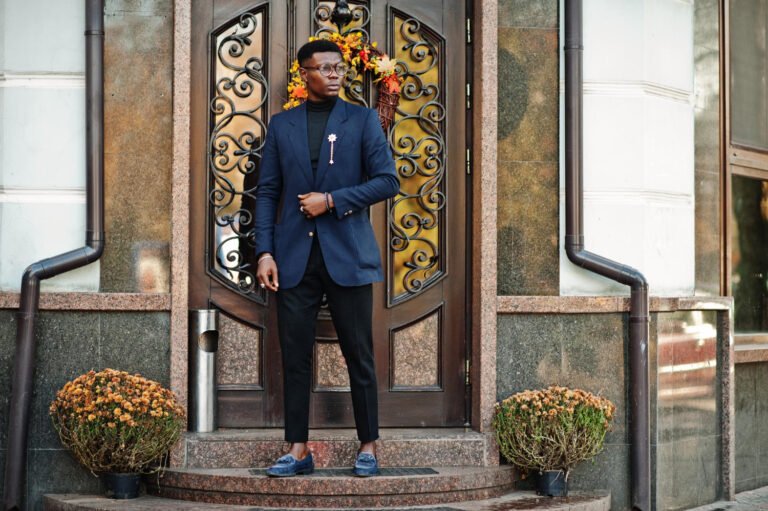
| Business Casual (upper) | Sport coat + odd trousers, dress shirt, no tie | Leather derbies or loafers | Consulting, banking-adjacent, senior client meetings |
| Business Casual (lower) | Chinos or wool-blend trousers, button-down or fine knit | Leather loafers or clean minimal sneakers | Most modern offices, agencies, healthcare admin |
| Smart Casual | Dark denim, elevated knitwear, unstructured jacket | Clean leather sneakers or suede boots | Creative industries, casual Fridays, dinner reservations |
| Casual | Any denim, t-shirts, sweatshirts | Sneakers of any kind | Weekend, warehouse, most remote work |
Notice that business casual actually spans two rows in that table. That’s the part almost no article addresses directly, and it’s the source of most confusion. If your office culture skews conservative (finance, law, government-adjacent, insurance), you should default to the upper row. If it skews modern (marketing, tech, media, most startups), the lower row is your safer read.
A quick way to gauge which side you’re on: look at what your direct manager and one level above them wears on a normal Tuesday, not what HR’s dress code PDF says. Written policies are almost always more conservative than actual office norms, and dressing to the written policy in a casual-leaning office can make you look like you’re trying too hard.
Read also: A Beginner’s Guide to Building a Suit Collection
The Core Business Casual Formula for Men
Strip away the ambiguity and business casual comes down to four components. Get these four right and you’ll be correctly dressed in 95% of offices.
1. Trousers: chinos or wool-blend dress pants, never denim (with rare exceptions). Cotton chinos in navy, khaki, olive, or charcoal are the workhorse of business casual. For a dressier register, a wool-blend trouser (look for a fabric blend that’s at least 60% wool with some poly or elastane for stretch and wrinkle resistance) reads more like “business” and less like “weekend errand.” Avoid anything with visible stretch shine or a slim-tapered “jogger” cut with elastic ankle cuffs — those read as athleisure regardless of fabric.
2. Top: a collared shirt or a fine-gauge knit. Oxford cloth button-downs and poplin dress shirts are the default. A merino or cotton-blend polo in a fine gauge (meaning tight, smooth knit, not chunky ribbing) is an underrated business casual piece — it reads more put-together than a t-shirt but doesn’t require ironing the way cotton poplin does. Avoid heavy waffle-knit henleys or anything with a graphic — those belong in the casual column.
3. Outerwear: an unstructured blazer or overshirt, optional but useful. An unstructured sport coat (meaning it has little to no internal padding or lining, so it drapes more like a heavy shirt than a stiff suit jacket) is the single most versatile piece you can own for this dress code. It instantly upgrades a chinos-and-polo outfit for a client meeting, then comes off for a normal day at your desk.
4. Shoes: leather, and closed-toe, always. Leather loafers (penny, tassel, or a simple venetian) and leather derbies are the safest bets. Clean, minimal leather sneakers (think a plain white or tan low-top with no chunky sole or visible branding) have become acceptable in the lower end of business casual over the last several years, but they’re still a gamble in conservative offices — reserve them for Fridays or after you’ve clocked the office norm.
Business Casual vs. Smart Casual: What’s the Real Difference?
The line most men can’t see is this: business casual is defined by what you remove from business formal, while smart casual is defined by what you elevate from casual wear. Business casual chinos and a button-down started life as office wear that got relaxed. Smart casual dark denim and a bomber jacket started life as weekend wear that got dressed up.
Practically, this means business casual leans on structured, traditionally “office” fabrics — poplin, oxford cloth, wool-blend trousers — even when the silhouette is relaxed. Smart casual leans on more casual fabrics — denim, suede, heavier knits — even when the styling is sharp. If you’re ever unsure which one an invitation calls for, business casual is the safer, more conservative choice; you can always remove a blazer to dial it back, but you can’t un-wear jeans if the room turns out to expect trousers.
Common Business Casual Mistakes (From Real Styling Sessions)
These are the errors I correct most often, roughly in order of frequency:
- Wearing dress shoes that are visibly worn down at the heel. Clients and colleagues notice scuffed, cracked leather before they notice anything else about your outfit — it’s the first thing that reads “not put together,” even under a good shirt and blazer.
- Sizing shirts too large “for comfort.” A shirt that balloons at the waist and has sleeves past your wrist bone reads sloppier than a slightly snug shirt. The fix isn’t buying tighter off the rack — it’s finding a brand whose cut matches your frame, or getting a $15–20 tailor take-in on the sides.
- Treating “no tie” as “no effort.” Business casual removes the tie requirement; it doesn’t remove the expectation of a pressed, intentional outfit. A wrinkled shirt with no tie looks worse than a wrinkled shirt with a tie, because there’s nothing distracting from it.
- Ignoring trouser break entirely. Chinos that pool heavily at the ankle or stop two inches above the shoe read as either “bought the wrong size” or “forgot to hem them.” Neither is the impression you want in a client-facing meeting.
- Over-indexing on a logo or brand statement. A large embroidered logo, a loud belt buckle, or a novelty sock peeking out undoes an otherwise correct outfit. Business casual rewards quiet consistency, not personality statements.
The Three Fit Checkpoints That Separate “Sharp” From “Sloppy”
Fabric and color choices matter, but fit is what actually reads as competence from six feet away. These are the three spots I check first on every client, regardless of budget:
- Shoulder seam: On a shirt or blazer, the seam where sleeve meets shoulder should sit right at the edge of your shoulder bone — not drooping down your arm (too big) and not pulling inward toward your neck (too small). This single checkpoint fixes 80% of “why does this look off” complaints.
- Trouser break: The point where your trouser hem meets your shoe. For business casual, aim for a “slight break” — a single, small fold of fabric resting on the shoe — rather than the fuller stack common in older suiting or the no-break “flood” look that’s gone out of favor. A tailor can hem trousers for $10–15, and it’s the highest-value alteration you can make.
- Collar gap: With the top button fastened (even if you don’t wear a tie), you should be able to fit roughly one finger between your neck and the collar — no more, no less. A gaping collar makes even an expensive shirt look like it’s not yours; a strangling collar reads as either weight change or wrong size ordered online.
How to Build a Business Casual Wardrobe on a Budget
You don’t need twenty pieces to cover this dress code — you need roughly seven that combine well. Here’s a realistic starting budget breakdown across three tiers:
- Budget tier ($30–60 per piece): Uniqlo and Target’s Goodfellow line make genuinely solid chinos and oxford shirts at this price point, with fabric quality that’s improved significantly over the last five years.
- Mid tier ($70–150 per piece): Bonobos, J.Crew, and Banana Republic Factory sit here, with better fabric weight, more consistent sizing runs, and trousers that hold a crease longer between washes.
- Premium tier ($150–350+ per piece): Brooks Brothers’ better lines, Suitsupply, and made-to-measure trouser programs offer natural fiber blends and construction that will outlast three budget-tier replacements — worth it once you know your exact fit preferences, not before.
A practical starting kit: two pairs of trousers (navy and stone chino), three shirts (one white oxford, one light blue oxford, one fine-gauge knit polo), one pair of brown leather loafers, and one unstructured navy blazer. That combination alone produces roughly a dozen distinct, correct outfits through simple rotation.
Seasonal Business Casual Adjustments
Humid summer climates (July meetings, outdoor client events): Swap wool-blend trousers for lightweight cotton or linen-cotton blend chinos, and choose an oxford cloth shirt in a lighter weight (look for “lightweight” or “summer-weight” on the label) rather than standard broadcloth. A linen-blend blazer breathes far better than wool-blend in 85°F-plus heat.
Cold climates: A merino wool sweater over a collared shirt (with the collar visible at the neck) reads as business casual and adds real warmth without needing an overcoat indoors. Avoid bulky cable-knits — the fine, smooth gauge is what keeps it in “business” territory rather than “weekend cabin” territory.
Frequently Asked Questions
Is business casual the same as smart casual? No. Business casual is a relaxed version of business formal and leans on traditionally structured office fabrics like poplin and wool-blend trousers. Smart casual is a dressed-up version of casual wear and leans on more relaxed fabrics like denim and heavier knits, even when styled sharply.
Can you wear jeans for business casual? Generally no. Most business casual dress codes exclude denim entirely, though a small number of modern offices allow a dark, unripped, well-fitted jean as an exception on casual Fridays. When in doubt, wear chinos or trousers instead.
Are sneakers ever acceptable for business casual? Clean, minimal leather sneakers in white or tan are acceptable in the more relaxed end of business casual, particularly in creative or tech-adjacent offices. Athletic sneakers, high-tops, and anything with visible mesh or branding are not appropriate.
Do you need a tie for business casual? No — the removal of the tie requirement is essentially the defining feature of business casual versus business professional. A well-fitted collared shirt worn open at the top button, without a tie, is correct.
What should I wear to a business casual job interview? Dress one notch above the company’s daily norm. If their office is business casual day-to-day, wear the upper end of that spectrum — a blazer, dress shirt, and wool-blend trousers — since interviews are the one context where slightly overdressed reads better than accurately matching the room.
Is a polo shirt business casual? A fine-gauge cotton or merino polo in a solid color is acceptable business casual in most modern offices, particularly paired with chinos and leather shoes. A thick pique polo with a large logo skews more toward golf-course casual and is a riskier choice for client-facing settings.
Read also: