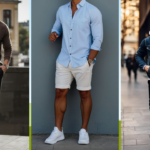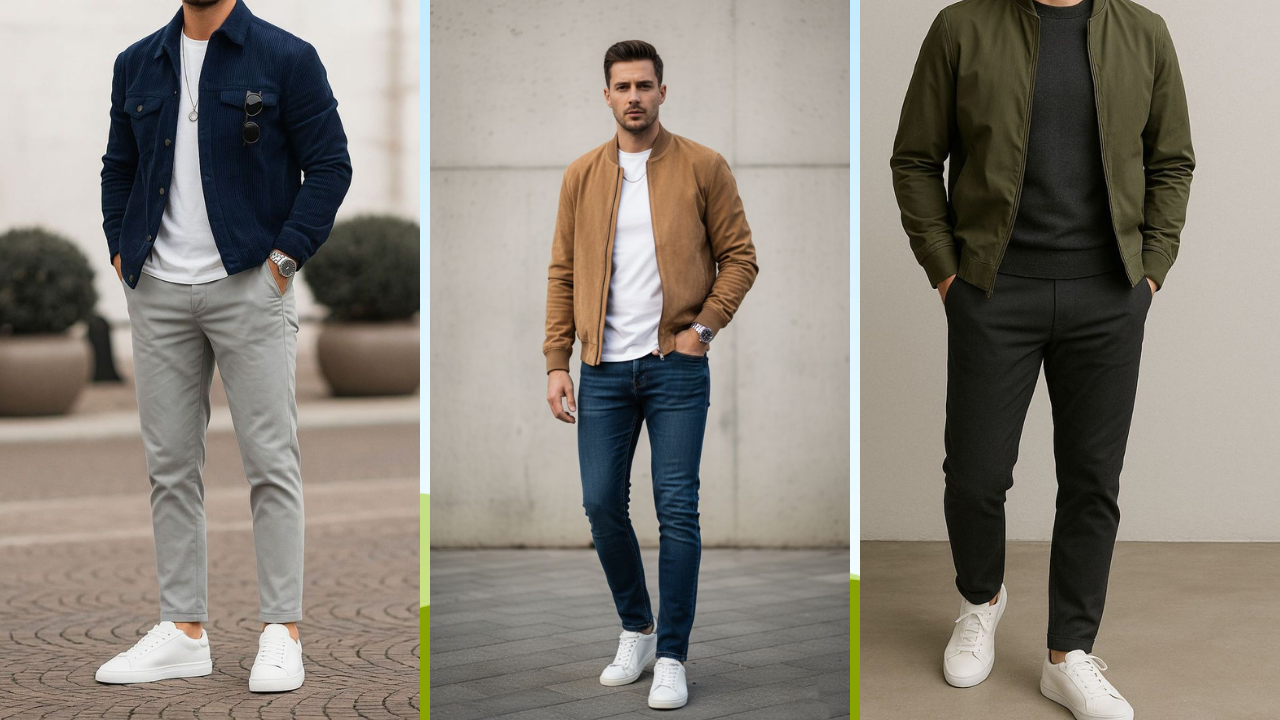
You’ve probably noticed that some men always look put-together without seeming like they’re trying too hard.
They’re not fashion experts or spending hours planning outfits—they’ve just cracked the code on a simple formula that works every single time. Meanwhile, you might be cycling through dozens of combinations, second-guessing yourself in the mirror, and still walking out the door feeling uncertain.
Here’s the reality: looking good doesn’t require a massive wardrobe or an innate sense of style. It requires understanding one reliable outfit formula and learning how to adapt it to your life.
This isn’t about following rigid fashion rules or copying someone else’s look exactly—it’s about having a foundational combination that works in nearly any casual or smart-casual situation, then making small adjustments based on where you’re going.
Master this single formula, and you’ll eliminate 90% of the guesswork from getting dressed while consistently looking sharp, confident, and intentional.
Why One Formula Is All You Really Need
The paradox of choice is real when it comes to getting dressed. The more options you have, the harder decisions become and the less satisfied you feel with your choices.
Men who always look good have typically reduced their wardrobe to a few proven formulas they rotate through with minor variations. This isn’t limiting—it’s liberating.
Think about successful people in any field. They often wear similar outfits daily because it eliminates decision fatigue and frees mental energy for more important choices.
Steve Jobs had his black turtleneck and jeans. Barack Obama rotated between blue and gray suits. Mark Zuckerberg defaults to a gray t-shirt. These aren’t fashion statements—they’re efficiency strategies that happen to look consistently good.
The one-formula approach works because it’s based on timeless principles rather than fleeting trends.
Fashion changes constantly, but the fundamentals of what looks good on men—proper fit, balanced proportions, appropriate formality, cohesive colors—remain remarkably stable.
When you build your go-to outfit around these fundamentals, you’re essentially trend-proof.
Having one reliable formula also builds confidence. When you know something works, you wear it with assurance. That confidence translates to how you carry yourself, how you interact with others, and how people perceive you. Uncertainty about your appearance bleeds into your demeanor, while certainty in your outfit allows you to focus on everything else.
The Core Formula: Breaking Down the Perfect Foundation
The formula that always works consists of five elements layered in a specific way: a fitted base layer, tailored bottom, neutral footwear, structured outer layer, and minimal accessories. This combination creates visual balance, works across seasons with slight adjustments, and adapts to nearly any casual or business-casual environment.
The base layer is your foundation—typically a well-fitted t-shirt, henley, or button-down shirt in a neutral color. This piece sits closest to your skin and establishes the outfit’s baseline formality. A plain t-shirt is most casual, a henley adds texture and interest, and a button-down elevates toward smart-casual. The key is fit: it should follow your torso’s shape without clinging or billowing, hitting right at your hip bone.
The tailored bottom means pants that fit properly—not baggy, not restrictive, with a clean silhouette that tapers slightly from knee to ankle. This is usually dark jeans, chinos, or tailored trousers depending on the formality you need. The bottom half of your outfit carries significant visual weight, so proper fit here is non-negotiable. Your pants should sit comfortably at your natural waist and break slightly at the shoe or sit just above it.
Neutral footwear grounds the outfit without drawing unnecessary attention. White or black leather sneakers work for most casual situations. Brown or black Chelsea boots, desert boots, or loafers elevate the formula for smarter occasions. The shoe should complement rather than compete with the rest of your outfit, which is why neutral colors in classic styles are essential.
The structured outer layer is what transforms this from basic to sharp. This could be a blazer, denim jacket, bomber, leather jacket, cardigan, or overcoat depending on weather and context. The outer layer adds visual interest, provides structure to your silhouette, and signals intentionality. It’s the difference between looking like you just threw something on and looking like you made a choice.
Minimal accessories complete the formula without overwhelming it. A simple watch, leather belt that matches your shoes, and possibly one subtle piece of jewelry (a chain, ring, or bracelet) is enough. Accessories should enhance, not dominate. The goal is cohesion and polish, not decoration.
The Everyday Version: Your Daily Go-To
For regular daily wear—running errands, coffee meetings, casual social events, working from home then stepping out—the everyday version of this formula is unbeatable in its simplicity and effectiveness.
The combination: Premium white or gray t-shirt + dark wash jeans + white leather sneakers + navy blazer or denim jacket + minimal watch
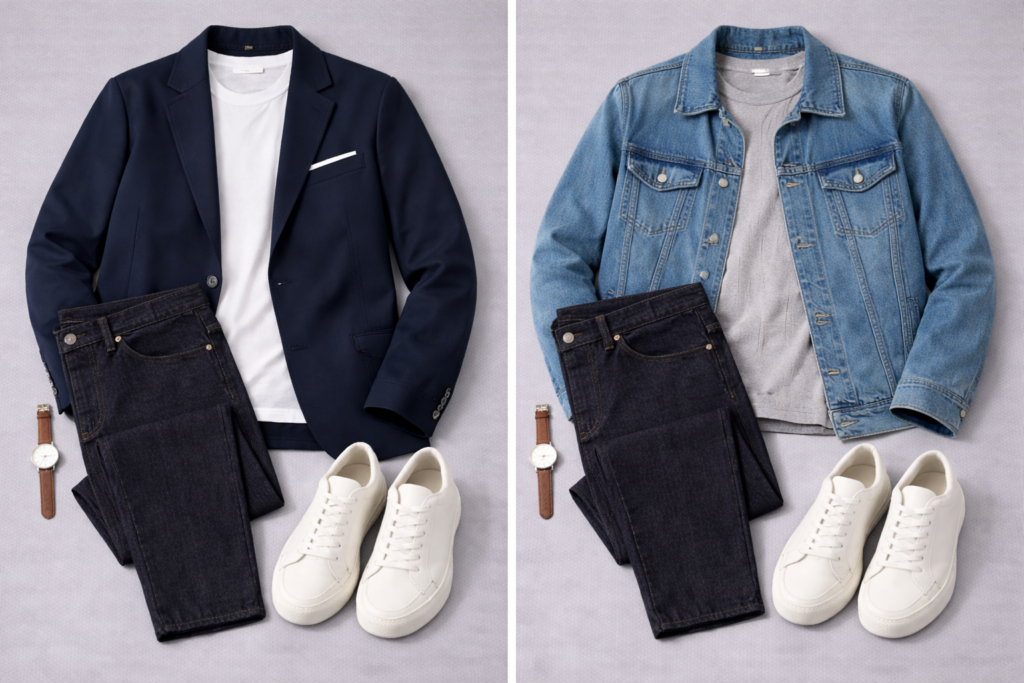
This outfit works because it balances casualness with structure. The t-shirt and jeans provide comfort and approachability. The blazer or denim jacket adds shape and signals that you put thought into your appearance. White sneakers keep things relaxed and modern. The entire combination takes two minutes to put on but looks like you care about how you present yourself.
Why it consistently works: The neutral color palette means nothing clashes or demands attention. The fitted t-shirt and tapered jeans create a clean silhouette that flatters most body types. The outer layer adds dimension and visual interest without complication. Most importantly, this outfit sits in the sweet spot of effort—not so casual that you look sloppy, not so dressed up that you seem out of place in everyday situations.
Seasonal adjustments: In summer, skip the jacket and let the fitted t-shirt stand alone, or replace it with a lightweight short-sleeve button-down in a neutral color. In winter, swap the blazer for a wool overcoat or add a crewneck sweater under the blazer for warmth. Spring and fall work perfectly with the base formula as-is, maybe adding a lightweight scarf for extra style points.
Context variations: Meeting someone for the first time? Keep the blazer. Just grabbing groceries? Skip it. Evening drinks? Swap the white sneakers for Chelsea boots. The formula remains the same; you’re just adjusting one element to match the situation.
The Smart-Casual Version: When You Need to Step It Up
For situations requiring more polish—business casual offices, dinner dates, nice restaurants, meeting her parents, professional events where suits aren’t required—the smart-casual version elevates the formula while maintaining its essential simplicity.
The combination: White or light blue oxford button-down + navy or charcoal chinos + brown leather Chelsea boots or loafers + navy blazer or tailored cardigan + leather watch and belt
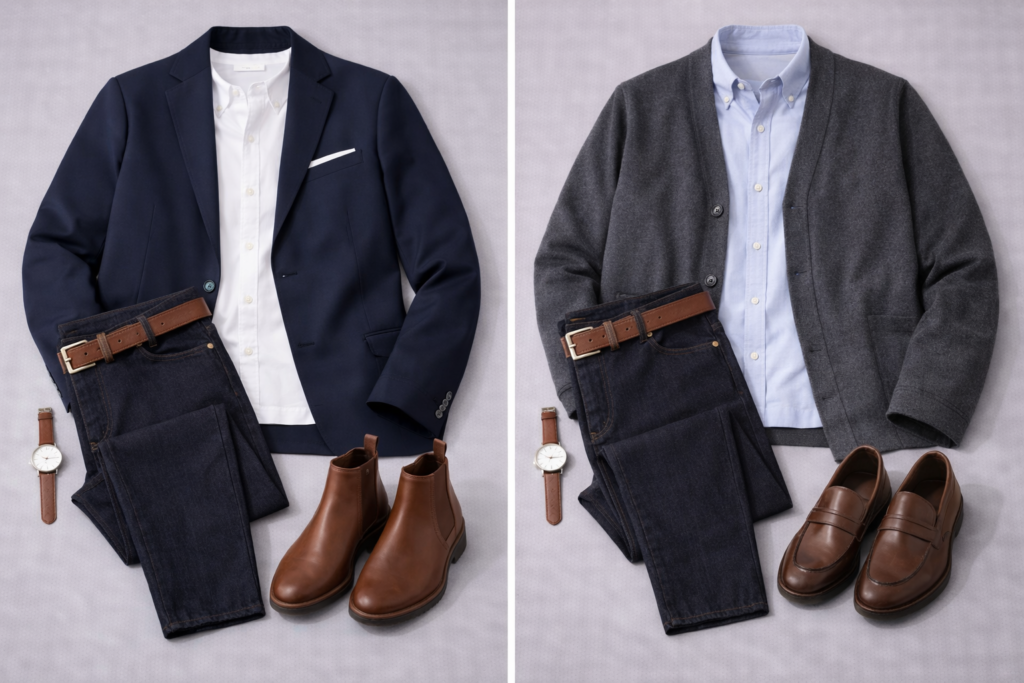
This version replaces the t-shirt with a collared shirt, swaps jeans for chinos, and upgrades sneakers to leather footwear. These substitutions push the formality up one notch while keeping the same structural formula. You’re still working with neutrals, fitted pieces, and a layered approach—just with slightly dressier components.
Why this works for elevated occasions: The button-down collar adds structure and formality. Chinos in navy or charcoal photograph better and read as more intentional than jeans. Leather boots or loafers signal sophistication and attention to detail. The blazer or cardigan maintains the layered structure while looking polished enough for professional environments.
Fit considerations: The oxford shirt should be fitted enough to tuck in if needed, though you can wear it untucked for a more relaxed vibe. Ensure the shoulder seams hit exactly at your shoulder point and the sleeves end at your wrist bone. Chinos should have a cleaner, more tailored fit than your casual jeans—think slim through the thigh with a slight taper. Leather shoes must be well-maintained; scuffed or worn footwear ruins the elevated effect.
Color flexibility: While the everyday version sticks to white, gray, and navy, the smart-casual version allows subtle expansion. Light blue or pink oxford shirts work beautifully. Charcoal or tan chinos provide variation from navy. Brown leather in different shades (tan, cognac, chocolate) adds warmth. Keep the additions within neutral and earth tone families to maintain versatility.
The Seasonal Adaptations: Making It Work Year-Round
The beauty of this formula is its seasonal flexibility. You’re not maintaining separate summer and winter wardrobes—you’re adapting the same basic structure with weather-appropriate pieces.
Summer modifications: Replace long-sleeve layers with short-sleeve versions. A fitted short-sleeve button-down in linen or lightweight cotton substitutes for the t-shirt or oxford. Swap jeans for lightweight chinos in stone, khaki, or light gray. Trade boots for loafers or minimalist leather sandals. The outer layer becomes optional—skip it entirely or use a lightweight, unlined blazer in cotton or linen for air-conditioned spaces.
The summer challenge is maintaining structure without overheating. Choose breathable natural fabrics like cotton, linen, and lightweight wool blends. Ensure your base layers fit well since you’ll often wear them without an outer layer. Light colors work better in heat, so introduce white, cream, light blue, and pale gray while maintaining the neutral palette principle.
Fall excellence: This is where the formula shines brightest. The layering structure perfectly matches transitional weather. Start with the basic formula, then add a lightweight sweater under your jacket when temperatures drop. Introduce earth tones—burgundy, forest green, rust, camel—through sweaters and accessories while keeping your base pieces neutral.
Fall invites textural play. Corduroy pants replace summer chinos. Cable-knit sweaters add visual interest under blazers. Suede Chelsea boots or desert boots complement autumn’s warmer color palette. A lightweight scarf in a complementary color adds sophistication without bulk.
Winter layering: The formula expands vertically in winter. Start with your base: fitted long-sleeve henley or button-down. Add a merino wool sweater or cardigan. Your jacket becomes a heavyweight wool blazer or you add an overcoat over your existing blazer. The structure remains—base, bottom, shoes, outer layers, accessories—but you’re stacking more pieces.
Winter footwear needs weather consideration. Chelsea boots in waterproof leather work for moderate cold and wet conditions. In harsh winter, you might need dedicated winter boots, but choose styles that maintain the clean, minimal aesthetic rather than bulky technical footwear.
Spring transition: Spring mirrors fall but in reverse—you’re shedding layers as temperatures rise. This is when lightweight bombers, unlined denim jackets, and cotton blazers excel. The unpredictability of spring weather makes the layering formula especially valuable—you can add or remove pieces as needed throughout the day.
The Color Theory: Why Neutrals Always Win
The reason this formula always looks good comes down to color theory and visual simplicity. Neutrals—black, white, gray, navy, beige, brown, olive—form the foundation because they’re universally flattering, always appropriate, and endlessly combinable.
The 70-20-10 rule guides color distribution in this formula. 70% of your outfit should be your primary neutral (usually navy, gray, or black). 20% should be a secondary neutral (white, beige, or a different shade of your primary). 10% can be an accent color or pattern through accessories, a subtle layer, or your footwear.
For example: navy blazer and navy jeans (70%) + white t-shirt (20%) + brown leather watch strap (10%). Or: gray chinos and charcoal cardigan (70%) + white oxford shirt (20%) + burgundy pocket square (10%). This distribution creates visual interest without chaos.
Tonal dressing takes this further by using various shades of the same color family. All-navy outfits, varying grays, or earth tone combinations create sophisticated, cohesive looks with minimal effort. Different textures in the same color prevent monotony—think navy cotton t-shirt, navy wool blazer, and navy cotton-blend chinos. The subtle variation keeps things interesting while maintaining the formula’s simplicity.
When to introduce color: After mastering the neutral formula, introduce color through your base layer or accessories, never through foundational pieces like jackets or pants. A burgundy henley under a navy blazer adds personality while maintaining versatility. A forest green sweater with gray chinos and brown boots brings warmth to fall outfits. Keep colored pieces in muted, sophisticated tones rather than bright primaries.
The contrast principle: Ensure enough contrast between your top and bottom halves to create visual definition. All-dark outfits (black on black on black) can work but require careful attention to texture and fit to avoid looking flat. More reliably, pair dark bottoms with lighter tops or vice versa. Dark jeans with a white t-shirt and light blazer creates clear, flattering contrast.
The Fit Factor: Why This Formula Fails When Sizing Is Off
Even the perfect formula fails if the fit is wrong. The difference between this outfit looking average and looking exceptional comes down to how each piece fits your specific body. Generic sizing rarely works perfectly, which is why understanding fit and using tailoring are non-negotiable.
The t-shirt test: Your base layer t-shirt should pass these checks: shoulder seams align with your shoulder point (where your shoulder meets your arm), sleeves end mid-bicep, the body follows your torso without excess fabric, and the hem hits at your hip bone. If you can pinch more than an inch of fabric at your sides, it’s too big. If the fabric pulls across your chest or stomach, it’s too small.
Pants that actually work: The waistband should sit comfortably at your natural waist (where your body bends when you lean sideways) without needing a belt to hold them up. The rise (the distance from waistband to crotch seam) should be appropriate for your build—too short looks uncomfortable, too long looks sloppy. The leg should taper slightly from knee to ankle, creating a clean line without being restrictive. The hem should either break slightly on dress pants or sit just above the shoe on casual pants.
Jacket structure: Your outer layer shoulders must align with your actual shoulders—this is the most important fit element because it’s expensive or impossible to alter. The jacket should button or zip comfortably without pulling. When buttoned, you should be able to fit one fist between your chest and the jacket. Sleeves should end at your wrist bone, allowing about a half inch of shirt cuff to show on dress shirts. The hem should cover your back pockets on casual jackets or end at mid-thigh on overcoats.
The tailoring investment: Buy clothes that fit correctly in the shoulders and chest, then tailor everything else. Hemming pants, tapering legs, shortening sleeves, and taking in waists are relatively inexpensive alterations (usually $10-30 per item) that transform the fit. Budget tailoring as part of your clothing cost. A $50 shirt tailored for $15 looks better than a $100 shirt that doesn’t fit.
Body type considerations: This formula works across body types because it’s based on proportion and balance. Shorter men should ensure pants have minimal break and avoid overly long jackets that shorten the legs visually. Taller men can handle longer jackets and should ensure sleeves are long enough. Heavier builds benefit from structured outer layers that define the shoulders and avoid overly tight base layers that cling. Slimmer builds can handle more fitted pieces but should avoid anything too tight, which looks uncomfortable rather than sharp.
The Accessories That Elevate Without Overwhelming
Accessories in this formula serve a specific purpose: adding subtle personality and polish without dominating the outfit. The key is restraint—less is consistently more when it comes to men’s accessories.
The watch principle: One quality watch in a classic style outperforms a collection of trendy pieces. Choose either a simple analog watch with a leather strap (brown or black) for versatility, or a minimal metal bracelet watch in silver or gold tone. The watch should be proportional to your wrist—oversized watches look cartoonish on smaller wrists, while tiny watches disappear on larger builds. When wearing long sleeves, the watch should slide under the cuff comfortably.
Belt basics: Your belt should match your shoes in both color and formality. Brown leather belt with brown shoes, black belt with black shoes. The belt should be simple—minimal hardware, quality leather, classic width (about 1.25-1.5 inches). Avoid oversized buckles, excessive detailing, or anything that draws attention. The belt’s job is to create a cohesive line from your shoes upward, not to make a statement.
Subtle jewelry: If you wear jewelry, keep it minimal and intentional. A simple chain in silver or gold, a leather bracelet, or one ring maximum. Avoid wearing all of these simultaneously—choose one piece that complements your outfit. The jewelry should feel like part of your personal style, not a costume element you’re trying on.
The bag factor: When you need to carry items, choose a quality leather backpack, messenger bag, or briefcase that complements your aesthetic. The bag should be proportional to your frame and appropriate for the context. A leather backpack works for casual and smart-casual settings. A briefcase leans more professional. Avoid overly technical or sporty bags with the smart-casual formula—they clash with the polished aesthetic.
Seasonal accessories: Scarves, sunglasses, and hats enter the formula seasonally. A simple wool or cashmere scarf in a neutral or complementary color adds warmth and sophistication in fall and winter. Classic sunglasses (aviators, wayfarers, or minimal frames) work in warmer months. Brimmed hats or quality beanies can work in colder weather but require confidence to pull off—skip them if you’re unsure.
Read also: Best Street Style Outfits for Urban Men
Common Mistakes That Undermine the Formula
Understanding what doesn’t work is as important as knowing what does. These mistakes break the formula’s effectiveness and prevent you from achieving that consistently good look.
Overthinking and overcomplicating: Adding too many layers, colors, patterns, or accessories destroys the formula’s elegant simplicity. If you’re wearing a patterned shirt, patterned socks, multiple accessories, and trying to introduce three different colors, you’ve gone too far. Strip back to the basics. The formula works because it’s simple.
Ignoring the importance of condition: Wrinkled shirts, scuffed shoes, pilled sweaters, or faded jeans undermine even perfect fit and composition. The formula assumes your pieces are clean, pressed, and well-maintained. A crisp white t-shirt looks exponentially better than a dingy, worn one. Keep your white sneakers clean, polish your leather shoes, and steam or iron your shirts.
Mixing formality levels inappropriately: Wearing dress shoes with distressed jeans and a graphic t-shirt creates visual confusion. Similarly, athletic sneakers with a tailored blazer and dress trousers rarely works. Keep formality consistent across the outfit. If you’re going casual on bottom (jeans and sneakers), keep the top casual or smart-casual (t-shirt or oxford with a casual jacket). If you’re dressing up your footwear (leather boots or loafers), ensure your pants and top match that elevation.
Defaulting to baggy fit for comfort: Comfort doesn’t require excess fabric. Modern fabrics and proper sizing provide comfort in fitted clothing. Baggy clothes hide your shape and make you look heavier and less put-together. If your “comfortable” clothes are two sizes too big, you need better-fitting clothes in stretchier fabrics, not to keep wearing oversized pieces.
Neglecting grooming: The formula extends beyond clothes to your overall presentation. Unkempt hair, unmanaged facial hair, or obvious neglect of personal care undermines your outfit. You don’t need an elaborate grooming routine, but basic cleanliness, a decent haircut, and intentional facial hair management (whether that’s clean-shaven or a well-maintained beard) are part of looking good.
Buying pieces that don’t fit the formula: Impulse purchases that seem cool in isolation but don’t work with your existing wardrobe break the formula’s efficiency. Before buying anything, visualize it within the formula. Does it replace an existing piece? Does it work with at least three other items you own? If not, skip it regardless of the sale price or how much you like it in the moment.
Quick Wins: Immediate Improvements You Can Make Today
You don’t need to rebuild your entire wardrobe to implement this formula. These immediate actions improve your look today using what you probably already own.
Audit your t-shirts: Pull out every t-shirt you own and try them on honestly. Keep only the ones that fit properly through the shoulders, chest, and torso. Toss or donate anything faded, stretched out, stained, or ill-fitting. If you don’t have one perfect white t-shirt, buy three this week—this is your highest-priority purchase.
Get your best jeans hemmed: Take your favorite dark jeans to a tailor and have them hemmed to the correct length (breaking slightly on the shoe or ending just above). This $10-15 alteration makes a dramatic difference in how your entire lower half looks. While there, ask about tapering the leg from knee to ankle if they’re baggy below the knee.
Clean your sneakers: If you’re wearing white leather sneakers that are dirty or scuffed, clean them thoroughly with a magic eraser or leather cleaner. Fresh white sneakers elevate every casual outfit. If they’re beyond saving, replace them—this is a foundational piece worth investing in.
Add one blazer: If you don’t own a navy blazer, this is your second priority purchase after white t-shirts. It transforms jeans and a t-shirt into a smart-casual outfit instantly. Don’t overthink it—find one that fits well in the shoulders (tailor everything else) in unstructured or semi-structured navy.
Match your belt to your shoes: Go through your belts and shoes and ensure you have matching pairs. Brown leather belt and brown leather boots. Black belt and black dress shoes. If you’re missing the belt for your best shoes, buy it. This small detail makes your outfits look more cohesive and intentional.
Steam your shirts: Invest $30 in a handheld steamer and use it on your button-downs and t-shirts before wearing. This takes 60 seconds and makes a noticeable difference in how polished you look. Wrinkled shirts signal carelessness; crisp shirts suggest attention to detail.
Frequently Asked Questions
Can I really wear the same formula every day without looking boring?
Absolutely. The formula provides structure, but variation comes through colors, textures, and proportions within that structure. Monday might be white t-shirt, dark jeans, white sneakers, and navy blazer. Wednesday could be gray henley, charcoal chinos, brown Chelsea boots, and camel cardigan. Friday might be light blue oxford, navy chinos, loafers, and a navy blazer. Same formula, completely different visual outcomes. The formula is invisible to others—they just see you consistently looking good.
What if I work in a more formal environment that requires suits?
The formula adapts to formal environments by shifting each component up one formality level. Your base layer becomes a dress shirt. Your tailored bottom becomes suit trousers. Your footwear becomes oxford or derby dress shoes. Your outer layer becomes a suit jacket. The accessories include a tie and pocket square. The structure remains identical—base, bottom, shoes, outer layer, accessories—just executed with more formal pieces. You’re still using the same layering logic and neutral color approach.
How do I make this formula work for my personal style?
Personal style emerges through your specific choices within the formula’s framework. Someone into minimalism might choose all-black monochrome with clean lines and zero accessories. Someone with workwear aesthetics might use denim, canvas, and earth tones with rugged boots. Someone preppy might favor pastels, loafers, and classic patterns. The formula accommodates all these styles because it’s about structure and proportion, not specific aesthetics. Choose colors, textures, and silhouettes that resonate with you while maintaining the core principles.
Is this formula appropriate for dates or trying to impress someone?
This formula is ideal for dates because it looks intentional without trying too hard. The smart-casual version—button-down, chinos, Chelsea boots, blazer or cardigan—works for 90% of date scenarios. You look like you care about your appearance without seeming like you agonized over it. Confidence matters more than complexity, and knowing your outfit works lets you focus on conversation and connection rather than wondering if you’re dressed appropriately.
What’s the minimum investment to implement this formula?
You can execute this formula well with approximately $500-800 if shopping strategically: $100 for three quality white/gray t-shirts, $150 for two pairs of well-fitting jeans or chinos, $100 for white leather sneakers, $200 for a navy blazer or versatile jacket, $50 for a basic watch, and $100-200 for essential accessories (belt, shoes if needed). This assumes you’re buying mid-range quality and utilizing sales. You can spend more for higher quality or less by shopping secondhand and budget retailers. The key is fit and condition, not price tags.
Making the Formula Your Daily Default
The outfit formula that always looks good isn’t a rigid uniform—it’s a flexible framework that eliminates guesswork while ensuring you consistently look sharp. By understanding the core structure (fitted base, tailored bottom, neutral footwear, outer layer, minimal accessories) and how to adapt it for different contexts, seasons, and personal preferences, you build a reliable approach to getting dressed that works every single time.
Start by implementing the basic everyday version: well-fitted t-shirt, dark jeans, clean sneakers, and a structured jacket. Wear this combination until it feels natural and you understand why it works. Then expand into the smart-casual version for situations requiring more polish. Notice how the formula adapts to different seasons, contexts, and moods while maintaining the same essential structure.
The real power of this approach reveals itself over time. You stop standing in front of your closet feeling overwhelmed. You stop buying random pieces that don’t work with anything else. You stop second-guessing yourself in the mirror. Instead, you reach for your proven formula, make small adjustments based on the day’s needs, and walk out confidently knowing you look good. That confidence—not the clothes themselves—is what people actually notice and respond to. Master this one formula, and you’ve solved the daily challenge of looking good without thinking about it.
Read also: